
During my semester abroad in Granada, Spain, I was fortunate to have received the Givens Scholarship. This provided me with the incredible opportunity to explore the Renaissance movement across different European cities, and explore firsthand how specific art and architecture have played a role in the development and character of European cities related to the movement.
The two most impactful cities I visited related to the movement were Florence (the birthplace of the Renaissance), and Prague. Although there were shared architectural similarities in certain parts of the cities, each provided a very unique “vibe” in how the Renaissance movement still flourishes, centuries later.
In Florence, I spent the majority of my time observing art inside the Uffizi Gallery, looking at the works of Leonardo da Vinci, Michaelangelo, and Raphael, to name a few of the artists. A recurring theme that I continually came across was the presence of the Christian faith, created with a sense of realism, yet somehow merged with mythology (a seemingly weird mix to me). The best piece that exemplified this was, in my opinion, Botticellii’s Primavera (pictured below).
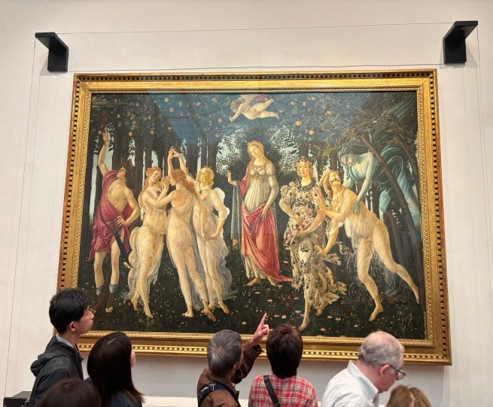
I could have easily spent the entire weekend inside of that museum, and consider it a MUST if you are heading to Florence in the future.
My afternoon in Florence was filled with a (very) long walk through the Boboli Gardens, and the periodic stop at one of their many famous Churches. The two “headliners” were the Basilica di Santa Croce, the largest Franciscan Church in the world (and the resting place of many famous artists, writers, and scientists), and the Florence Cathedral, commonly referred to by the locals as the “Duomo” (the Italian word for “Cathedral”).
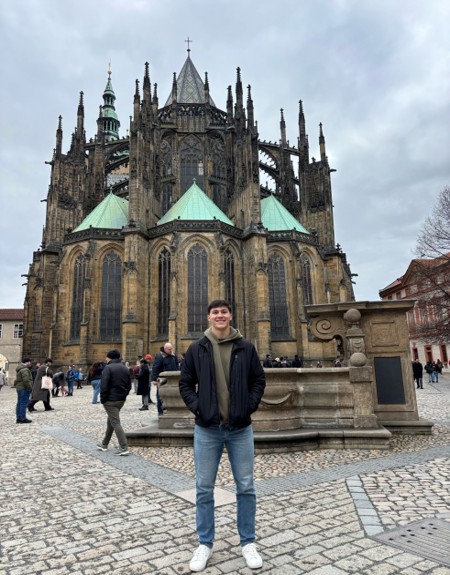
My visit to Prague was equally as amazing, but the presence of the Renaissance movement wasn’t quite as prominent. I visited the Prague Castle Complex (see pictured), along with the Schwarzenberg Palace, and although the architecture was stunning, it felt much more gothic than Renaissance, something I did not see during my trip to Florence. As I learned during my trip, this makes sense due to the time period that the Renaissance movement finally reached modern-day Czechia, “colliding” with the peak of the Gothic era.
I am incredibly grateful for those who make the Givens Scholarship possible for Wabash Students. It made for an incredibly enriching and immersive learning experience during my semester abroad.
