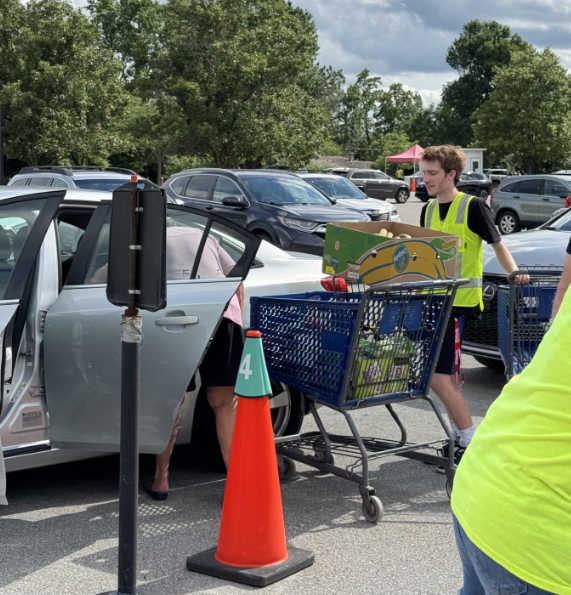
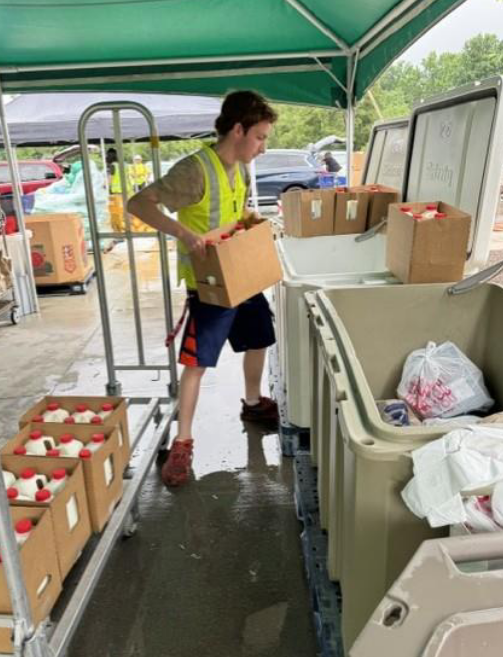
This summer, I had the opportunity to serve as a volunteer at Crooked Creek Food Pantry. During this time, I was able to learn more about the barriers that prevent people from receiving healthcare and what can be done to address them. These barriers present themselves in many different forms. Without proper nutrition, any treatment that health professionals administer will be less effective. Thus, the food pantry is attached directly to the Eskenazi Health Center Pecar. Here, doctors can recommend that patients visit the food pantry. This also helps some neighbors get over the stigma that comes with going to a food pantry. Some people are also not able to get reliable transportation to the food pantry making it, so the pantry must be organized in a way where individuals without a car are able to take food home as well. One of the most impactful moments was watching one of the neighbors without a car walking off into the distance carrying all the food they were able to bring. It was then that one of my co-workers, Jeff, said, “that is why we do what we do.” That moment really stuck with me as it is easy to just go through the motions and forget that the work you do anywhere in the health field is bound to have a profound impact on somebody’s life. Another barrier that I was not expecting to encounter was a language barrier, English was not the primary language of many of the neighbors. Many of them spoke Spanish and there was also a significant Haitian creole speaking population. Through my shadowing at the clinic, I learned that there were interpreters and some doctors that spoke various languages as well as some volunteers at the food pantry but that is yet another barrier that if not properly addressed, would cause significant problems in receiving adequate healthcare. I am grateful for the opportunity given to me by Wabash College, Zach Fawbush, Kathy Hahn Keiner, and to all of the amazing people I had the privilege of working with this summer.