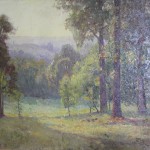
T.C. Steele’s experience during his 1880 stint in Germany not only taught him how to be a better painter, but it changed his desire and focus as an artist. Prior to Germany, he received commission for his portrait paintings, but still had a desire to pursue landscape pieces. Thus, while he was studying in Germany, it made him even more sensitive to various nuance’s of the landscape and the way other European artists depicted it. He remarked about the German landscape: “There are more color intense contrasts and less atmosphere or tone, and the effects of the haze are thicker.” This gave Steele a new way of perceiving the environment, which then influenced his style.
While at the academy in Munich, Steele’s transition to landscape paintings took effect. Approximately 6 of every 12 paintings commissioned by Steele at this time were landscapes. Then, after a year of study in Munich, Steele moved to the country and met an American expatriate named J. Frank Currier. Steele worked under this landscape artist for the remainder of his time in Germany, while all others went back to Munich. This was a pivotal point for Steele due to the homely “rustic” feel he gained in his paintings under the encouraging guidance of Currier.
It was obvious that Steele wished to continue this landscape painting upon his return to Indiana, saying he “intend[ed] to do as much landscape work as portraiture.” This notion solidified at an International Expedition in Munich’s Glasplast. Steele noticed that when artists studying in Europe returned home, they produced different kinds of work with the same land they previously worked with. Steele likened it to be that they rediscovered characteristics of the land and people from their new skills. This reaffirmed Steele’s desire to return to Indiana, hopefully to rediscover its beauty in a different way than before.
Back to the main page on T.C. Steele, Afternoon Sunlight