
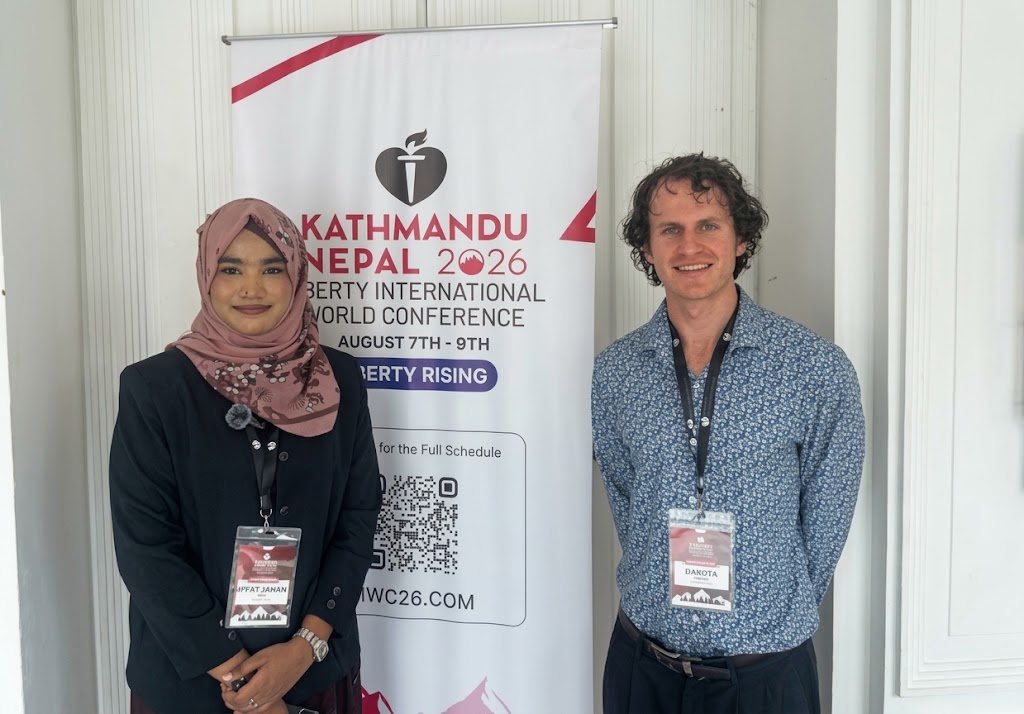
Dakota Stacy ’27, like many Little Giants, has a passion for travel and liberal learning—so he’s all about getting outside the classroom, going far beyond his studies as a philosophy and economics major. But this past summer, he managed to easily surpass these aspirations—visiting six countries across three continents, circumnavigating the Northern Hemisphere between Europe, North Africa, and Japan before returning to Wabash. And all this came after spending two months in the nation’s capital, learning about global fiscal policy with a leading think tank.
Dakota’s summer break began in May at the Mercatus Center at George Mason University. The atmosphere, he says, “was very entrepreneurial. I could do what I wanted to if it made sense.” A former study abroad experience in Japan was a logical way to leverage his enthusiasm for that part of the world. “I did three projects on Japanese fiscal debts,” he notes. In his work, he critiqued Modern Monetary Theory (MMT) by analyzing the country’s massive public debt, the largest per capita in the world, which sits at a gross liability of 270% of GDP. That alone might sound alarming, but he also discovered that the country “incentivizes the formation of an ice cream cartel that fixes prices.”
Not too distracted by the idea of debt-related dairy desserts, Dakota worked assiduously under the supervision of Veronique de Rugy, George Gibbs Chair in Political Economy and Senior Research Fellow at the Mercatus Center. There he completed several related pieces posted on The Unseen and The Unsaid, “a newsletter about economic freedom, fiscal policy, and common-sense policy reforms,” an outlet that is seen throughout the public-policy world and halls of Capitol Hill.
After his deep dive into the Japanese economy, Dakota continues, “I started to get a little bit more experimental towards the second half of the internship. So I did stuff about Russia… And I also did a project about birds.” What do fowl have to do with classical liberalism? In his piece at Free Exchange, Dakota explored how birding serves as a massive, global conservation effort that relies on a “triad” of governments, nonprofits, and the free market.
He focused on how much civil society contributes to environmental protection: “Unlike hunting (arguably the second biggest), birding is where conservation is the passive activity itself. Birdwatchers collect data for researchers; researchers make discoveries, and these findings can contribute to protecting land.” Many casual bird watchers do exactly this even in using the most popular bird apps, like eBird and Merlin Bird ID, generating massive databases for ornithologists at a fraction of the cost of traditional environmental tracking. And it all builds to support an international ecosystem: “Your existence (food) depends on birds… Hummingbirds, sunbirds, and honeycreepers pollinate a plethora of flowers. You also would not have coffee were it not for birds.”
After two months in muggy D.C., a summer that would have been brag-worthy enough, Dakota flew to Europe to participate in The Stephenson Institute’s summer seminar in Prague, stopping for a day en route to see Paris. He woke up at 4:00 a.m. on his first morning to walk around before the seminar started, seeing the historic, old-world streets and castle at first light. After one week of enjoying an exploration of classical-liberal themes with several dozen students, many Wabash gentlemen among them, he departed for Egypt for a brief vacation with his father and brother to see Cairo and the pyramids. “It was like 110 every day,” he says. “But it was great because I mean there’s like nobody there when it’s hot. So all the temples and monuments had very few people,” almost like a private tour.
Leaving his family, Dakota headed east to attend the 40th Liberty International World Conference, this year in Nepal. But on the way, of course, Dakota managed a one-day stop in the crossroads of Istanbul, Turkey. “My favorite thing was called the Blue Mosque. It was built in the 17th century to imitate the Hagia Sophia,” he says. Then, perhaps well-timed for transiting between programs focused on markets, he visited the legendary bazaar: “It’s this street with like 100,000 different items. And it just keeps going and going… so many different people doing lots of different things.”
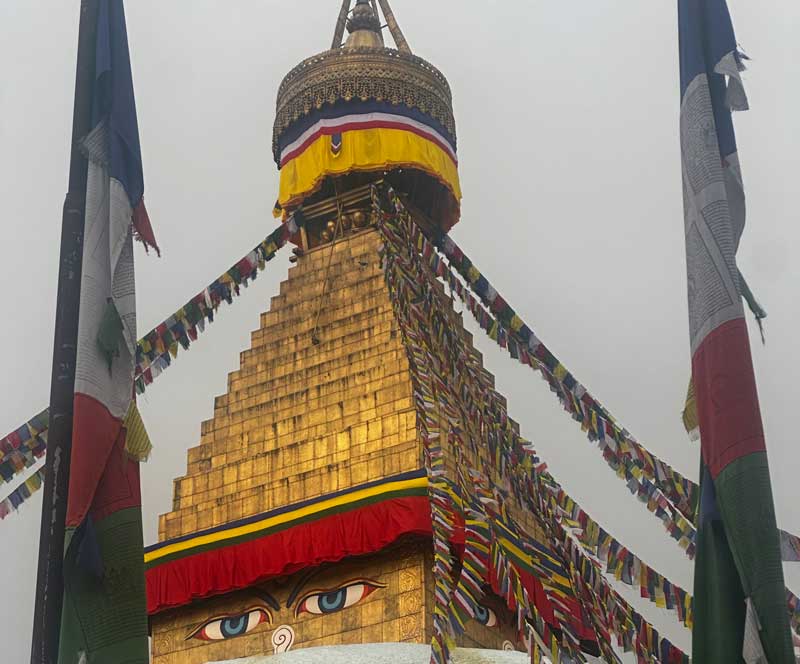
Arriving in Kathmandu, Dakota met people from all over the world for an exploration of classical liberal themes—including market reforms in Nepal, longevity and biotechnology, and Adam Smith. Encountering Dr. Hiroshi Yoshida, a Japanese tax expert and public accounting specialist, Dakota was able to present the fiscal analysis he was working on in D.C.: “When someone later came up and asked Hiroshi a question about the yen situation, he had me pull out my article to explain the problem.” Fortunately, there was also time for more than academic panels, as he had a chance to explore the authentic Kathmandu outside the conference halls.
During a night trip to the Hindu “god of animals” temple, Dakota reports on “things I could never have imagined.” In his own words:
Ashes of active open air cremations covered the starry sky, mourning families sent deceased loved ones down the river which separates “preserver from destroyer,” and all the while a fire performance ritual took place on the highest peak in the riverbank. Given the temple’s name, you can bet animals too were plenty: monkeys, owls, cows, dogs, cats, etc. I also stepped on cow waste by accident and to my surprise, was told I was very lucky and hugged by my Nepali friend and nearby strangers.
It might have been the perfect end of the summer, but a short flight east brought Dakota again to Japan, literally bookending a journey across so many topics. Seeing friends there, he reflected on his time. “Thank you all again so much for this opportunity,” he tells The Stephenson Institute. “It was not just a marvelous one, but truly life-changing.”
