
From a nationally recognized think tank on the East Coast to an academic institute out West and a Midwestern policy journal, Stephenson Institute students spent this past summer engaged in original research connected to classical liberal approaches.
The American Institute for Economic Research (AIER) frequently collaborates with the Institute, but this year we were particularly excited to have several Wabash students accepted to its highly competitive summer internship program. Based in the picturesque Berkshire mountains of Massachusetts, AIER’s residential program introduces undergraduates to economic research through independent exploration and rigorous mentoring.
As Brandon Ruder ’27 reports, “it was a really great experience. I definitely learned how to write a lot better and gained a lot of confidence, especially when it came to discussions and reading carefully.” His research on government decision-making applied a public choice approach to the new education freedom tax credit rolled out by Donald Trump, which is scheduled to launch in 2027. The work included analysis of the incentives, social costs, and political costs shaping decision-making.
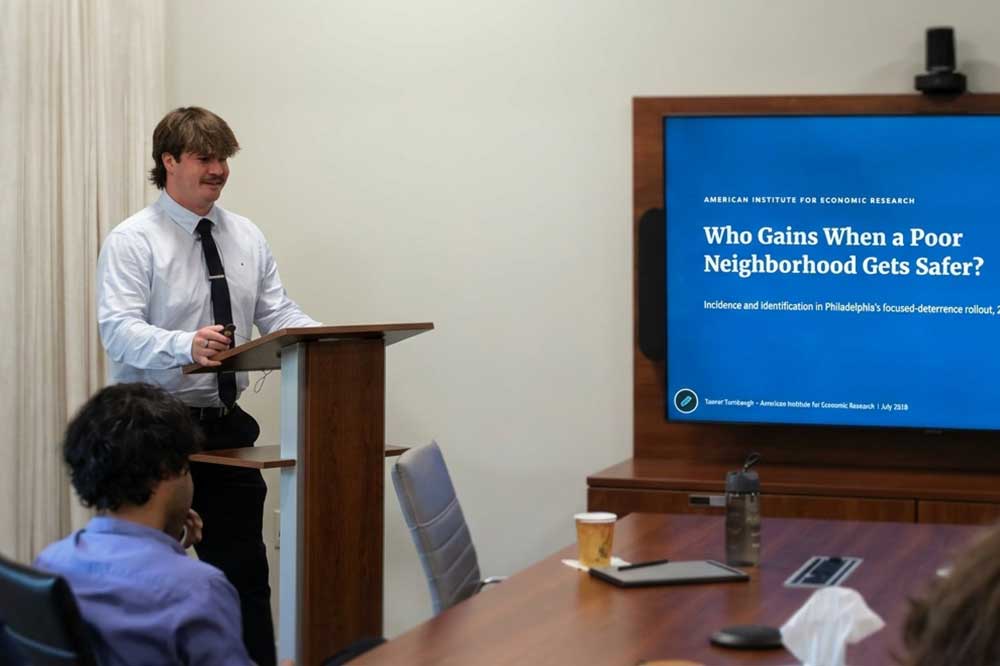
Tanner Turnpaugh ’27 also appreciated his time at AIER, particularly as he is considering graduate school in economics. Initially thinking about an analysis related to Flock cameras, but not finding enough data to work with, Tanner then focused on the effectiveness of deterrence programs in South Philadelphia. “I put together a violent crime index and then was trying to see how that affects housing prices,” he explains. “I spent most of the summer learning how research actually gets done, which turned out to be less about running the regression and more about deciding which question was worth asking in the first place.” Tanner is also blogging on Substack, which he calls “Price Theory and Vibes.”
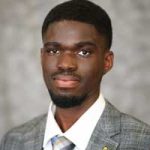
Another Wabash student, George Agbesi ’28, also spent the summer doing original research—but across the country in Southern California—as an undergraduate fellow at Chapman University’s Smith Institute for Political Economy and Philosophy. Working under Professor Eric Kimbrough, the head of the experimental economics department, George developed a data pipeline for a research paper concerning AI and human alignment. “It was a great experience, one of the best experiences I’ve had,” reports George, who hopes to pursue graduate studies in communication, social science, or business administration.
Beyond technical research, the Smith fellows cohort engaged in reading political economy and environmental books, including works by Alexis de Tocqueville and his unique insights on the nature of free association. As George reports, studying Tocqueville’s theories was a great starting point for his work on simulations: “I spent this summer… modeling, in code, what happens when that cooperation breaks down.” His work included using “oTree, a Python framework for running economic games with real participants,” and later using large language models for scoring them.
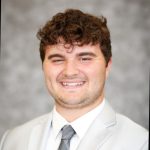
Back home in Indiana, Keagen Combs ’28 also utilized AI to explore how it can enable school decentralization, in particular the idea of “microschools.” Working with staff at Indiana Policy Review, he developed a policy white paper that outlined how a new school of only 50 students could operate. The small scale could be enabled and optimized by AI tools—in this case, software using individual learning where students progress at their own pace. “The big headline was nearly doubling teachers’ pay,” he says. In the new model, “we had the money to do that and we thought it would incentivize teachers more.”
Keagen reports that seeing an independent research project through all its stages—from initial research, collaboration with editors, and eventual completion—was “really, really fun.” And as for working with Indiana Policy Review, “I would definitely recommend it to students … to get published was amazing.”
