
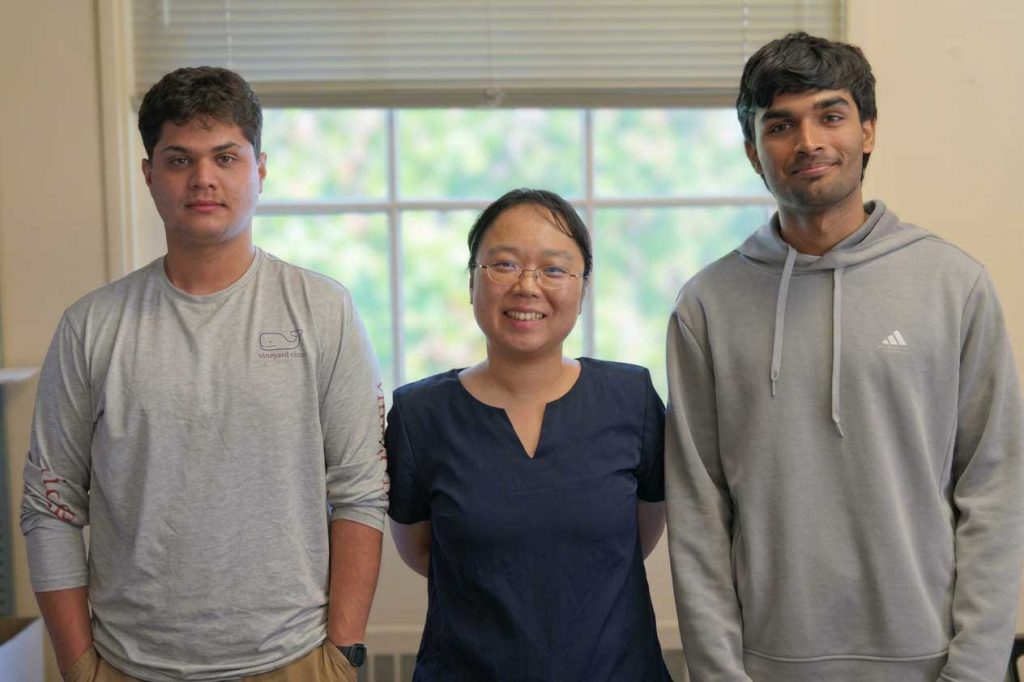
Why do some countries reach trade agreements after years of talks, while others choose to leave their negotiations? Wabash College BKT Assistant Professor of Political Science Huei-Jyun Ye thinks collecting data can help scholars understand these questions better, and so she engages with Wabash students to assist in producing this impressive clearinghouse of knowledge. This summer, two Stephenson Institute interns, Hari Sakthivel ’28 and Diego Banuelos ’27, worked with Dr. Ye on contributing to the project—including learning about the nature of international trade and enhancing their skills in using AI-assisted research.
“It gave me a new understanding of economics…how bilateral trade agreements work and what goes behind it,” Diego says. These agreements “can make or break relationships with different countries, and ultimately they affect their view of other countries.”
Unlike other students who have been involved in Dr. Ye’s project for over a year, Diego had just joined the team this summer and was new to learning about this topic and methods. As she explains, “with any new research assistant, it took him some time to understand the workflow and the logic of the coding process. I assigned him work on Africa, which was a largely untouched region in the project and one for which I did not expect information to be easy to find.” Yet by the end of the summer, Diego excelled and exceeded Dr. Ye’s expectations, fully completing the challenging assignment of covering an entire continent: “What I have appreciated most in working with him is his honesty and sense of responsibility.”
Hari, who had been assisting Dr. Ye already for some time, found the summer to nonetheless further refine how AI-assisted research could enhance their productivity. “It used to be a really tedious task, going through government websites and checking for archives to find the information,” he reports. “But after using AI, it does all of the grunt work for you,” Hari admits. Dr. Ye was pleased to find students like Hari, who “first led me to think seriously about how AI might be incorporated into the coding process, and he took the initiative to experiment with prompts that could facilitate the work.” But did it make things too easy? “At one point, he joked that he seemed to be introducing an approach that might replace him, but our work this summer made clear that this is not the case,” answers Dr. Ye.
“There were a lot of times where links would be broken or [AI] would get the data from the websites wrong,” Hari explains. “Then we would have to go in and correct it.” Similarly, Dr. Ye cautions that “while AI-assisted coding can help streamline the workflow, it is not fully reliable, and its use has only made careful human judgment more important.” Hari in particular, she says, “has also been candid and responsible in how he uses AI, and he has helped teammates clarify parts of the procedure as our workflow became more standardized.”
The team also managed to make progress despite collaborating mostly using virtual platforms. “This summer, we worked from different corners of the world,” Dr. Ye says—with her mostly in Taiwan, Hari back home in India much of the time, and Diego largely in Crawfordsville. Still, for all their travel and time away from campus, they forged an incredibly productive team. Dr. Ye also arranged for Diego to fly down to Dallas—breaking up the quiet period of the summer on campus—so he could attend the Taiwan Research Academy, providing him an opportunity to learn more about research methods.
“It was a bit intimidating at first,” Diego says of the intense schedule in Dallas. “I didn’t know most of the people and my cohort were master’s and PhD students.” But Diego was willing to push his limits, and Dr. Ye confirmed he could handle the challenge: “He does not pretend to understand something when he does not, and he is not afraid to ask questions. He is also candid when he falls behind but then works hard to catch up.”
Involving undergraduates in serious research can have its challenges. But when organized as both a learning experience and a contribution to building knowledge, all involved feel a sense of pride and accomplishment. As Dr. Ye sums up the summer, “I hope to continue giving these hard-working students a range of experiences and exposing them to different opportunities.”
