
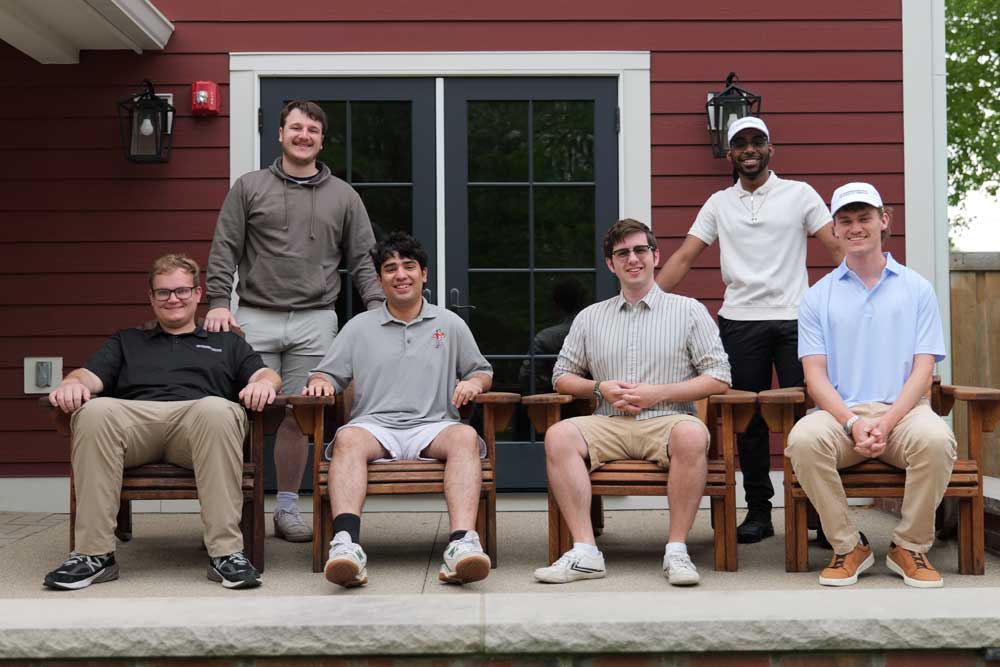
Nine members of the Wabash College Class of 2026 graduated this spring with something more than a diploma: a sharpened understanding of free societies, expanded professional networks, and firsthand experience gained through their time at the Stephenson Institute for Classical Liberalism.
Founded in 2021 and made possible by the generosity of alumnus Richard J. Stephenson ‘62, the Institute connects students with internships, conferences, speakers, immersion trips, and its Agora lunchtime forums—open discussions designed to give students practice in free expression on controversial topics.
While the Institute’s offerings are open to all Wabash students, this cohort was particularly involved in our programs, so we are proud to celebrate these new graduates as they move on to the next stage of their careers. Their majors span Computer Science, Economics, Rhetoric, Art, and Philosophy, Politics, and Economics (PPE)—and their hometowns ranged from places as close as Indiana and as far away as India.
For Arman Luthra (Computer Science, Jammu, India), his path began with a trip to assist at the Mont Pelerin Society conference in New Hampshire in 2023, followed by a summer internship in 2025 in a data engineering role at the American Enterprise Institute (AEI). As he graduates, Arman is taking a position at Skop Intelligence in California. “The talks on campus kept that momentum going,” Luthra said, “and eventually it led to my first real internship … in Washington, DC, which is what set up the role I’m starting now.” He also credits a grant-funded semester at George Mason University in the DC area as “one of the most important parts of my college experience.” Arman concluded by telling us that “the Institute has been one of the best parts of my time at Wabash.”
Ego Gonzales (Art/Political Science, Queen Creek, Ariz.), who is returning home to work in the Phoenix area, found his entry point through Agora. “The Agora talks were how I first came to be part of the Stephenson Institute,” he said. “They allowed me to not only share my thoughts with other students, but to look at others’ perspectives and try to challenge myself through conversations.” An Institute summer grant also sent him to Greece, where he learned about classical liberal ideas abroad and later shared what he learned with students and faculty back on campus.
Preston Art (PPE, Indianapolis) also went abroad, with two summers spent working at the Austrian Economics Center in Vienna, and both internships funded by the Institute. A highlight of his time there was conducting policy research on tax disputes with foreign investors in Spain and studying successful economic reforms in Ireland and New Zealand.
Albert Bernhardt (PPE, Orland Park, Ill.) is heading to Georgetown’s McCourt School of Public Policy, where he will be studying for a Master’s in Public Policy (MPP). In the summer of 2025, Albert was selected to participate in The Fund for American Studies’ summer internship program in Washington, DC, where he also interned at the Alliance for Innovation and Infrastructure. Albert’s transformative summer was made possible by the Institute’s student grant funding.
Tobey Condon (PPE/Classics, Watervliet, N.Y.), who earned Phi Beta Kappa honors and was named Moot Court Top Advocate, praised the Institute’s ability to open doors. “It allowed me to interface with relevant figures and topics and gain life experience in a way that no other program at Wabash could,” he said. Tobey spent the summer of 2025 at the American Institute for Economic Research (AIER), which works closely with the Stephenson Institute on other programs. Like Albert, Tobey also plans to pursue graduate study.
Isaac Grannis (Computer Science, Indianapolis), who won the David E. Maharry Prize in Computer Science and is headed to a systems engineering role in Indianapolis, valued the chance to engage working scholars. “Being able to interact and converse with academics actively doing research in the field… I could take some of that built up tacit knowledge and apply it to my own studies and life more broadly,” he said.
Several of our graduating seniors also worked part-time in the Institute’s offices, helping run all of our programs and sometimes assisting with research. They included:
Kale Helms (Economics/French, Owensburg, Ind.) will be joining the Orr Fellowship in Indianapolis. In 2024, Kale received Institute summer funding to intern at the Adam Smith Institute in London. “There is no better extracurricular programming on campus,” Kale remarked.
Eric Copeland (Rhetoric, East Chicago, Ind.) begins a management trainee role at Enterprise, citing the Institute’s collaborative atmosphere as a model for the culture he hopes to build as a future business leader and entrepreneur. Blake Discher (PPE, Grosse Pointe, Mich.) is another senior who assisted in running our office.
Together, these nine graduates embody the Institute’s founding aim: producing individuals who are humane, tolerant, and curious—equipped to conduct their own search for purpose in a free society.
