
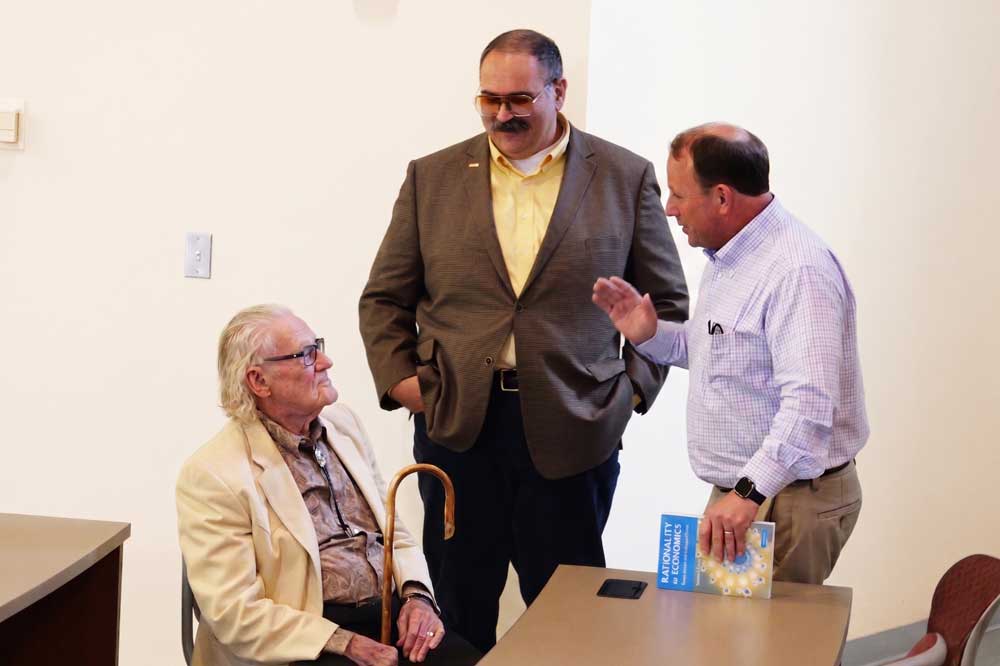
The Stephenson Institute for Classical Liberalism at Wabash College closed out a remarkable four-month run of programming this May, which notably included a keynote Ama-Gi Lecture from Nobel laureate Vernon Smith. This was just one highlight of a semester that also took eleven Wabash students to Rio de Janeiro and brought six visiting scholars to Crawfordsville, whose lectures ranged from Federal Reserve policy to Major League Baseball.
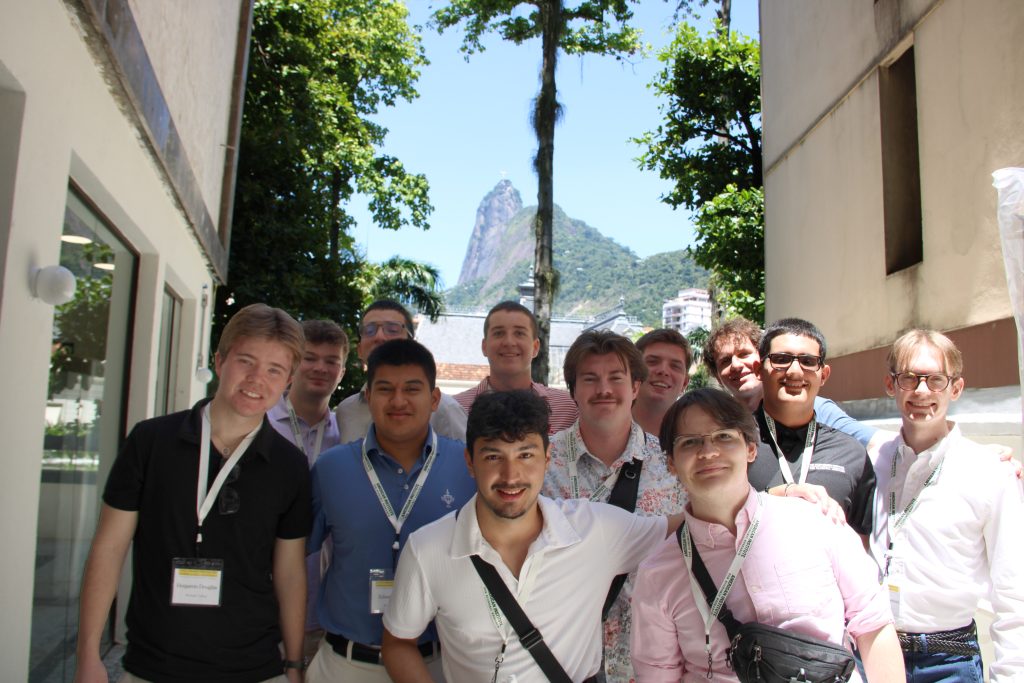
Our programming began just prior to classes starting, with Stephenson Institute staff taking eleven Wabash students on a week-long seminar on Classical Liberalism and International Trade to Rio de Janeiro. Students attended morning sessions led by an international roster of speakers, including Wabash’s own Nicholas Snow on black markets and economist Peter Earle on the connection between trade and finance, before exploring the city in the afternoons. “The trip was a great mix of intellectual development while seeing a beautiful city,” Tanner Turnpaugh ’27 reflected. It was “a meaningful blend of academic ideas and cultural immersion that broadened my perspective on global trade, classical liberalism, and the value of engaging with ideas well beyond the context of our own lives.”
Back on campus, the Institute’s lecture series kicked off on January 27 with historian Dr. Anthony Gregory of Stanford’s Hoover Institution, who drew on his recent book New Deal Law and Order to argue that Franklin Roosevelt’s expansion of federal criminal authority was as foundational to the modern American state as his social welfare programs. “The New Deal war on crime legitimated national enforcement authority,” Gregory told students. “By legitimating national authority, it built law and order in both the narrow sense and the broader sense and laid the foundations of modern government.”
A week later, Dr. Bryan Cutsinger of Florida Atlantic University took aim at the Federal Reserve’s narrative about post-pandemic inflation. Walking the audience through Fed Chair Jerome Powell’s claims that the inflation surge was “exogenous” and that the Fed’s framework was “irrelevant,” Cutsinger methodically dismantled each point. “Inflation’s not exogenous,” he concluded. “The Fed did not respond appropriately and aggressively.” FAIT (Flexible Average Inflation Targeting, a monetary policy framework adopted by the Federal Reserve in August 2020), “certainly did play a role in contributing to the post-pandemic inflation.” He urged the Fed to adopt a nominal GDP level target rather than its current approach.
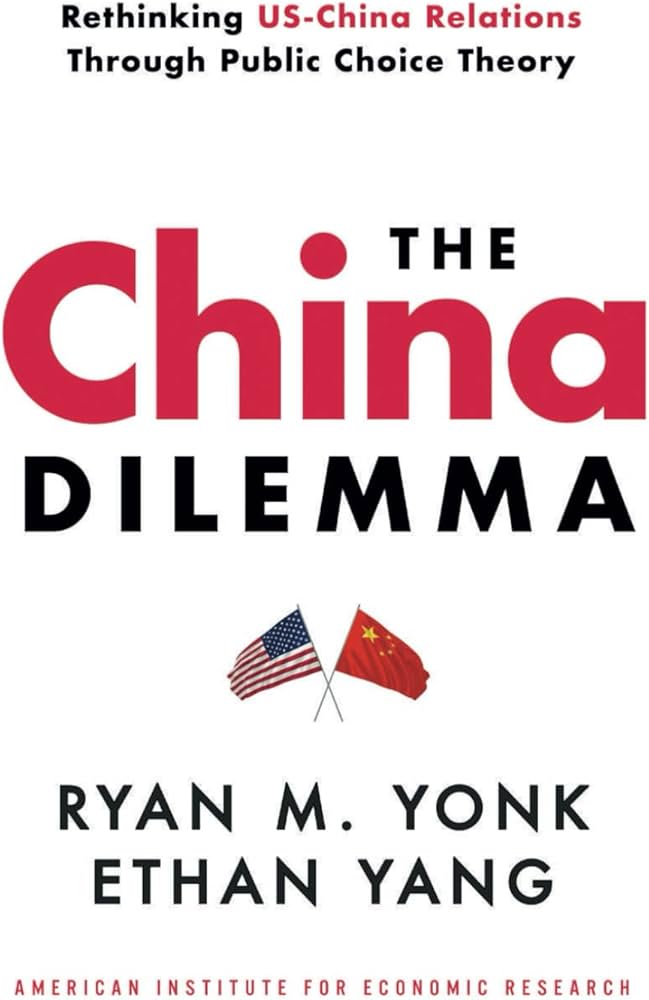 On February 17, Dr. Ryan Yonk of the American Institute for Economic Research came to discuss his book The China Dilemma, applying public choice theory to U.S.–China relations. Yonk pushed back against framings that treat China as a monolithic adversary, including a quote he attributed to a current U.S. senator: “Western businesses and financiers are selling the Chinese Communist Party the rope it will use to hang the United States.” If that’s where the analysis begins, Yonk argued, the policy options narrow dramatically. “Countries don’t have opinions. People have opinions,” he told the audience. “People then come to lead countries and they make decisions that are consistent with their interests.” Asked at the end of the talk where hope might come from in dealing with authoritarian regimes, Yonk replied: “The single best thing the US could do is lose our obsession with immigration policy and instead have a proactive engagement with other countries.”
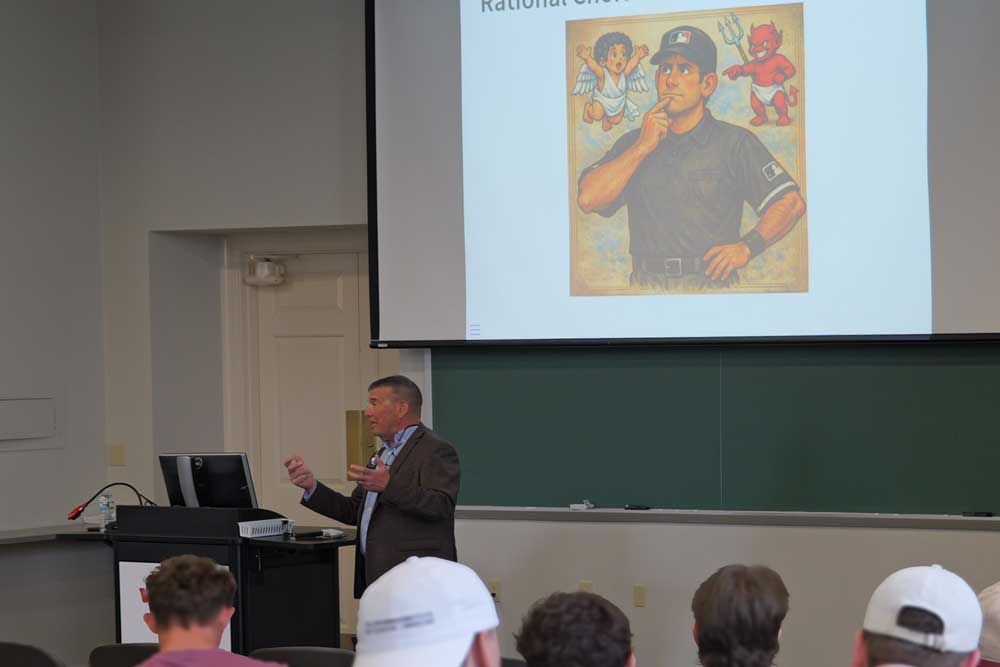
The series took a lighter turn on March 31 when Dr. Tony Carilli of Hampden-Sydney College, a Division I baseball umpire as well as an economist, delivered a talk titled “Agency, Attitudes and Outs: An Economic Analysis of Racial Bias in Umpire Ejections.” Working through a principal–agent framework, Carilli argued that any racial bias in ejections should appear in the categories with the highest monitoring costs (private exchanges between umpire and player) rather than in clearly observable infractions. Along the way, he made a passionate pitch for the liberal arts. “Read literature,” he urged the students. “It’ll help you. It’ll help you get empathy and it’ll make you a better writer and a better communicator.”
A clear highlight of the semester came on April 1, when Professor Vernon Smith, a 2002 Nobel Prize winner in experimental economics, delivered this year’s Ama-Gi Lecture at Wabash. Smith, now 99, opened by telling students he wanted to talk about “the importance of being wrong,” recounting three moments when he and his profession had taken wrong turns—a key part of eventually finding new breakthroughs. Returning to his first market experiment at Purdue University in January 1956, a short drive from Crawfordsville, Smith recalled the astonishment of watching prices converge to equilibrium even though no participant had full information about supply or demand. “I had discovered a law of nature,” he said. “You didn’t have to have complete information. People just had to have an opportunity for learning. They’re not stupid.”
That discovery, Smith explained, sent him back to Adam Smith: first to Chapter 7 of The Wealth of Nations, and then, more importantly, to The Theory of Moral Sentiments. He argued that order in society emerges from the rules people develop to get along with one another, beginning in childhood. “Our playmates are not as indulgent as our parents,” he said, paraphrasing Smith. “If we do something they don’t like, they let us know.” Justice, for Adam Smith, “has only to do with one thing, and that’s security from injury,” Vernon Smith noted, distinguishing this from beneficence, the good things people do for each other voluntarily. He closed by tying experimental results on trust games back to a proposition Smith had written over two centuries ago: “Here he is writing in 1759. He’s got a proposition that predicts this, the outcome of this experiment. That’s why you need to read Adam Smith.”
The series concluded on April 28 with Dr. Claudia Williamson Kramer of the University of Tennessee at Chattanooga, who returned to themes Vernon Smith had opened just days earlier. Drawing on her West Virginia roots and her research on economic freedom and gender, Kramer argued that capitalism, properly understood as a system of private property rights enabling rational economic calculation, has done more for human flourishing, including for women, than any alternative. “If wealth is better than poverty, if life is better than death, if knowledge is better than ignorance, and liberty is better than oppression,” she concluded, “then capitalism deserves a defense.”
