
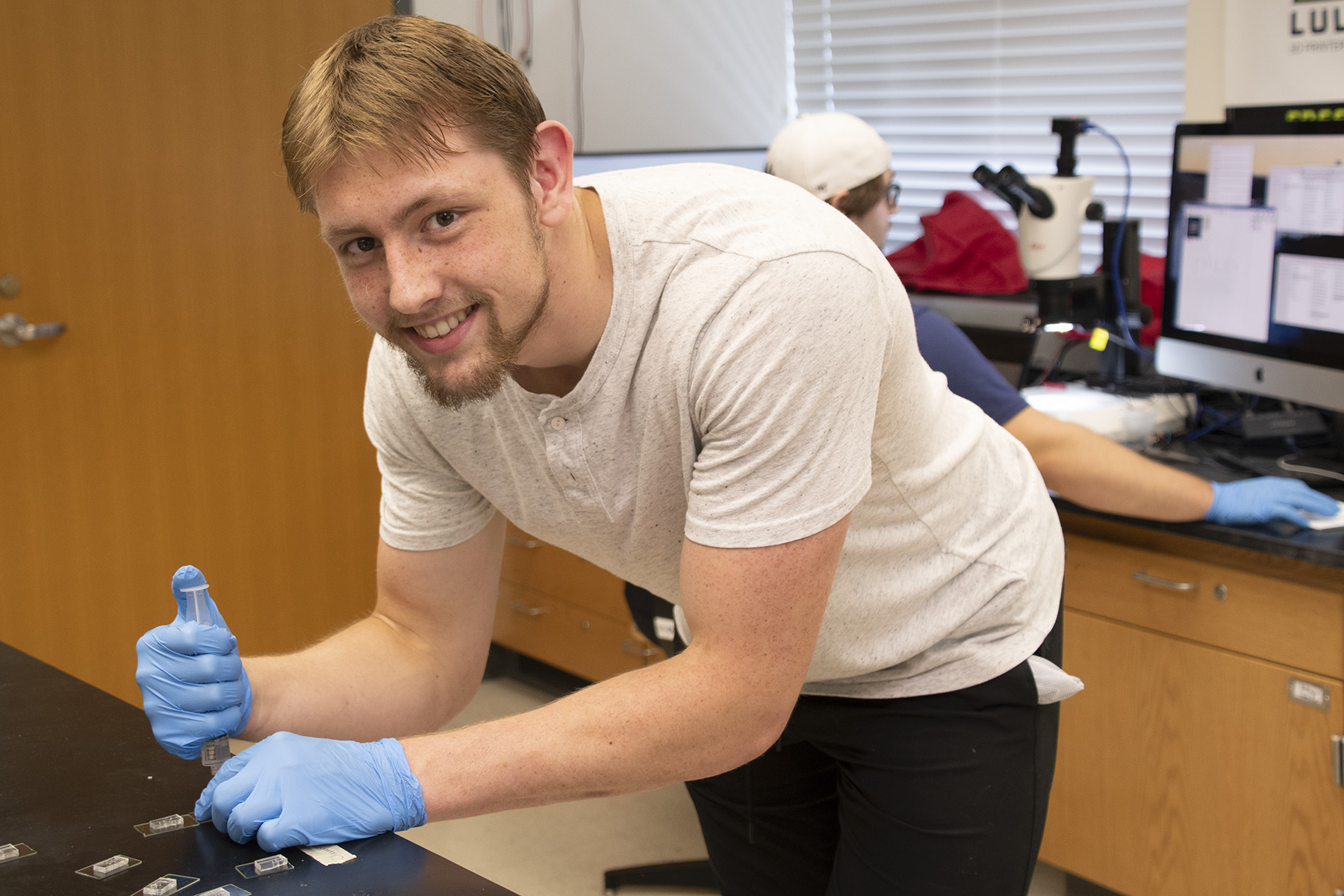
Over the summer, I was fortunate enough to work with Dr. Tompkins and Mathew Moran where we observed the microfluidic properties of metals in salt water. The objective of our research was to pinpoint an average value of potential difference across a chemical reaction that produced a precipitate. Multiple solutions of metal salt compounds like cobalt chloride, iron chloride, and nickel chloride were used to stimulate a reaction with hydroxide. Over the course of this internship, we obtained a multitude of promising results that allowed us to range the potential difference between 10 to 60 millivolts. By using Picolog’s ACD-24 with a terminal block, we were able to gather and graph data points of the potential difference across the reaction of the metal salt compound and hydroxide.
Through deliberation with my partner and Dr. Tompkins on how to create an easily manufacturable and repeatable methodology to obtain a consistent reaction; we decided to create a microfluidic device that is capable of producing coflow. One of the
reasons we chose to manufacture a microfluidic device is that creating a tube that is microns in diameter will allow us to easily manipulate the flow of the fluid. Thus, allowing us to achieve coflow, a byproduct of two fluids in laminar flow coming into
contact in a controlled environment. Before starting my time researching with Dr. Tompkins and Mathew Moran, I didn’t even realize a reaction like this was possible. My prior knowledge led me to believe that, despite any unique properties of a fluid, all fluids would be mixed together like turbulent flow.
Another interesting technique I’ve learned throughout my time researching was the passivation of materials through the Zepto one plasma chamber. The way we utilized this process was to bound a PDMS microfluidic device to a glass plate. I’ve learned that the passivation of both the PDMS and glass plate removes an oxygen atom or a carbon dioxide atom from the molecular structure of both materials. After passivating both materials you can apply a significant amount of evenly flushed force onto each
passivated surface to achieve a covalent bond between the PDMS and the glass plate.
Also, throughout the experimental stage of my summer research, I was given the opportunities to develop most if not all of the skills that are involved in being a microfluidic lab technician. For instance, in the solution manufacturing stage I calculated the mass required for a molar solution, and I reduced the molar concentration by calculating a ratio of distilled water needed to be added. On the experimental side I learned how to operate a fluid pump called Fusion Touch, and I recorded data with Picolog’s data sets and graphing features. On top of that, I’ve learned to code a dynamic graph that shows data being plotted on the graph in an interval of time with Wolfram’s kernel. Even going so far as to sync up the data plotting on the graph with a video of the reaction stimulating precipitate growth by reconfiguring the framerate of the plotting on the graph.
From the beginning of starting my summer research I was fascinated with learning the reasons behind our manufacturing and experimental processes. That is why I believe that my most utilized Clifton skill was learner, since I have learned a great number of interesting processes and skills. I am very fortunate and grateful that Dr. Tompkins and Wabash College allowed me to take part in their research program. Thank you to all of the donors and alumni who made research like mine possible
