
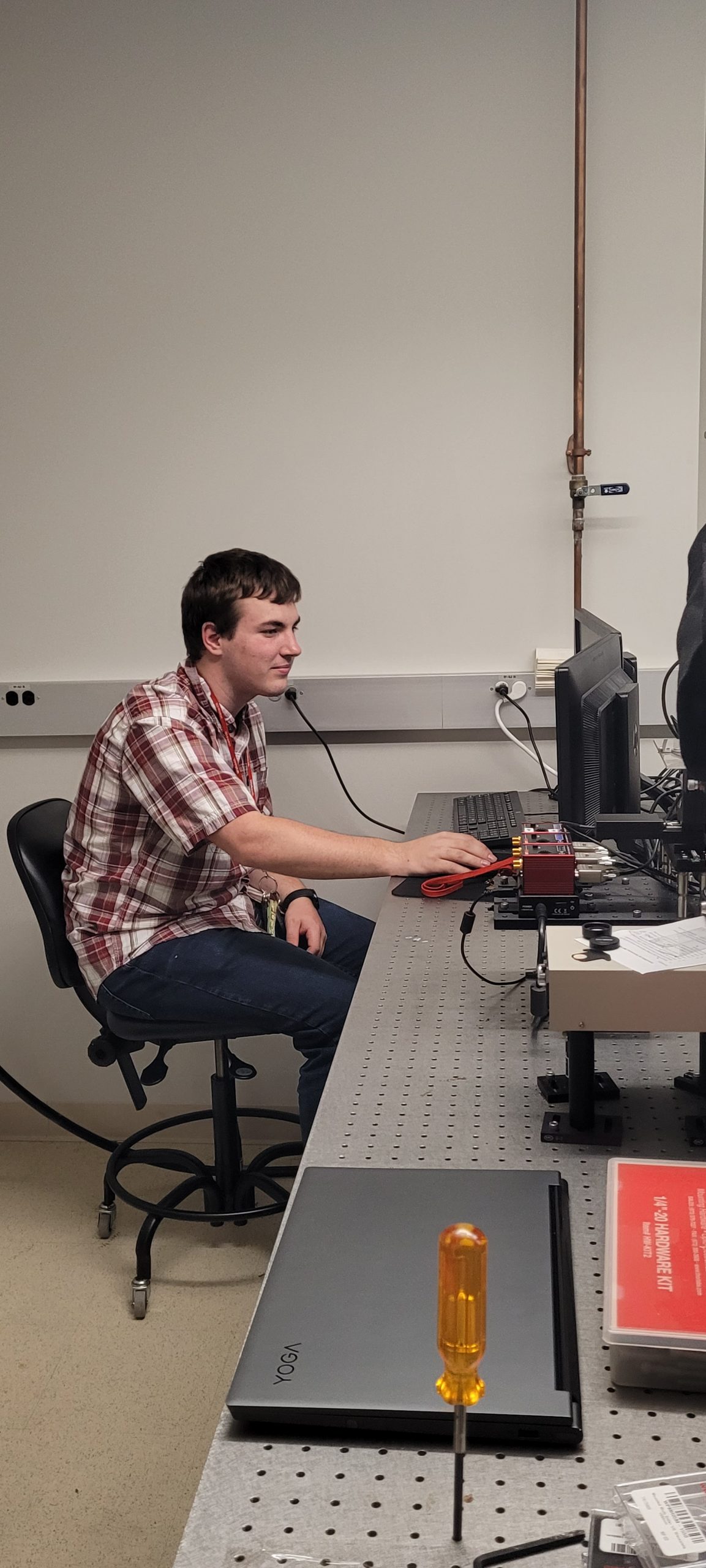
Alexander Litts ’24 — First, I would like to thank Dr. Schmitt and the Wabash Chemistry Department for this research opportunity. I would also like to thank Corteva for funding this project. Finally, I would like to thank career services for all their help. During this internship, I was able to further develop my knowledge of chemistry and laboratory techniques with the help of fellow students and professors.
My research this summer focused on analyzing pesticide formulations using Second Harmonic Generation Microscopy or SHG for short. Every year, new pesticides are being developed in hopes of creating a pesticide that lasts longer, has less of an effect on the environment, and is much more effective than the ones currently in use. This process can be very expensive and time-consuming. What makes pesticides effective is the active ingredients. Many times, the active ingredients of pesticides have a certain crystal structure that will make them SHG Active. To be SHG active, their crystal structure must be noncentrosymmetric. This means that when a beam of light is shined at one of these crystals, the frequency of that original beam of light is doubled. By measuring this, we can produce images of these crystals. Because only the active ingredient is SHG active, we are able to selectively image just the active ingredient and no other materials. By doing this, we can analyze a pesticide formulation in a couple of weeks rather than the months that it currently takes in the industry.
In our research, we used a second harmonic generation microscope built by our professor Dr. Schmitt. we were able to image several pesticide formulations and how they broke down over time to see which formulation was more effective. To do this, we imaged the pesticides on a living leaf throughout several time points. Because the leaf is not SHG active, the only images we received were the crystals of the Active ingredient. Over time, we were able to see a decrease in the active ingredient on the leaf. To analyze the images, we used a program called ImageJ to determine the total SHG active area, which is just the area that has the active ingredient on.
