
George Go ’18 – Over the past few days, we’ve continued our excursions in Germany. This included visiting the Bebenhausen Monastery and the Schloss Museum, as well as having the privilege of learning about Germany’s political system from Wabash alumnus Dr. Jared Sonnicksen ’01, who is currently a post-doc at the University of Darmstadt.

On Wednesday morning, the group took a hike to visit the Bebenhausen Monastery. Although the trek up there a decent ways away, I think that I can speak for the majority of our group about how jaw-dropping the scenery of Bebenhausen was once we first arrived. Once we made our way down, we stopped and explored the monastery. An interesting fact about the monastery was that it was originally Roman Catholic and then reformed into Protestantism. The monastery showed this to us when we took a closer look at the building’s unique architecture.
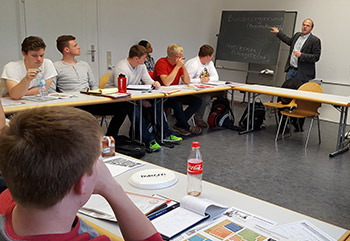
The next morning we were greeted by Sonnicksen. After Wabash, he received a Fulbright to continue his studies at the University of Bonn with the help of a scholarship. He then taught English for 3 years, and struggled a little bit with the culture shift between Germany and America. Sonnicksen discussed how different the political system in Germany is compared to the United States. He talked, for example, about the Gewaltenteilung, or separation of powers. This included their parliamentary system being broken up into the Bundestag and the Bundesrat.
Later that evening, we took an excursion to the Schloss Museum of “Alte Kulturen,” or old cultures. In this museum, they have ancient artifacts dating back to around 40,000 years ago. These cover the time of the ice age and the cognitive revolution in human development, and they represent some of the earliest art objects every discovered. We were able to see first-hand ancient figurines of various animals carved out of Mammoth ivory and then discovered tens of thousands of years later in caves outside of Tübingen. The museum also included pieces of ancient culture from areas such as Greece, Italy, and Egypt. We saw things such as ancient ceramic art, swords and armor, and sarcophaguses throughout the museum. Towards the end of the museum, we got to see sculptures of Roman and Greek figures including the goddess Athena to famous war heroes such as Alexander the Great. Although it has only been the first few days of our trip, it is easy to say that we have seen a lot of interesting things thus far.
