
David Boulware’s ’96 research starts with paperwork.
Boulware, a professor of infectious diseases and international medicine at the University of Minnesota, studies cryptococcal meningitis, a severe fungal infection of the central nervous system. He calls it a neglected disease, which shapes his entire research process.
Because most of his on-the-ground research happens in Africa, his team has to do everything, Boulware explained during a recent campus visit. They write protocols, secure regulatory approval, handle FDA requirements, and run the clinical trials themselves.
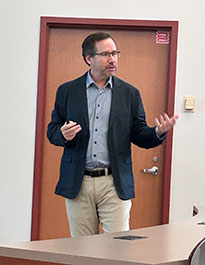
“Clinical trials are a research skill and there are people who specialize in that,” he said. “A lot of it is troubleshooting and logistics, not fancy science, but it’s how to actually get stuff done. It’s a lot of logistics and paperwork, and knowing what you need to do. So much of clinical trials is documenting and having the structure of a clinical question and designing a study to answer that.”
Because much of his work takes place halfway around the world, materials often are shipped or carried in. They plan for power outages, riots, and even Ebola outbreaks that can immobilize a country.
Having largely worked with the same group for nearly 20 years, his teams are resilient and built on trust. Through their research, Boulware and his colleagues have found success in shaping public policy on delivering care in resource-scarce areas. Seven of his lessons learned in research have become World Health Organization guidelines. Two others have been adopted by the U.S. Food and Drug Administration.
“I do research to change policy,” he said, “in this case on an international level. Previously, we were talking about a 50% mortality rate for meningitis patients who entered the hospital. Now it’s a treatable disease. The (local) physicians and our team are super enthusiastic because people come in on death’s door and they can walk out of the hospital with a pretty good quality of life. That’s amazing. Yes, there is still death, but we are working on that.”
Boulware is also educating the next generation of researchers, as students are a part of his team, which gives them an opportunity to experience the impacts of medicine firsthand.
“This is what medicine is about,” he said. “It’s not just filling out notes and billing. It’s real medicine and, really, it’s quite rewarding for students.”
