
By Eli Johnson
Today for the second half of our tour we got the chance to walk through the Jewish Quartering section of Krakow. This was very interesting to me as we got the opportunity to see a variety of differing structures. Some of these structures I had not seen before this trip.
After we ate, by a big circular building with shops surrounding it our tour guide, Ewa, informed the group of this buildings use. The circular building with shops in used to be the building where meat was cut. She went on to explain to us that this was very important in Jewish culture as only certain meats can be consumed and they must be cut a certain way. I found this interesting as she went on to explain to us that Christians would buy the meat that was cut incorrectly at a discounted price.
Ewa then led us to many different synagogues in the area. Including the first two ever constructed in Poland.
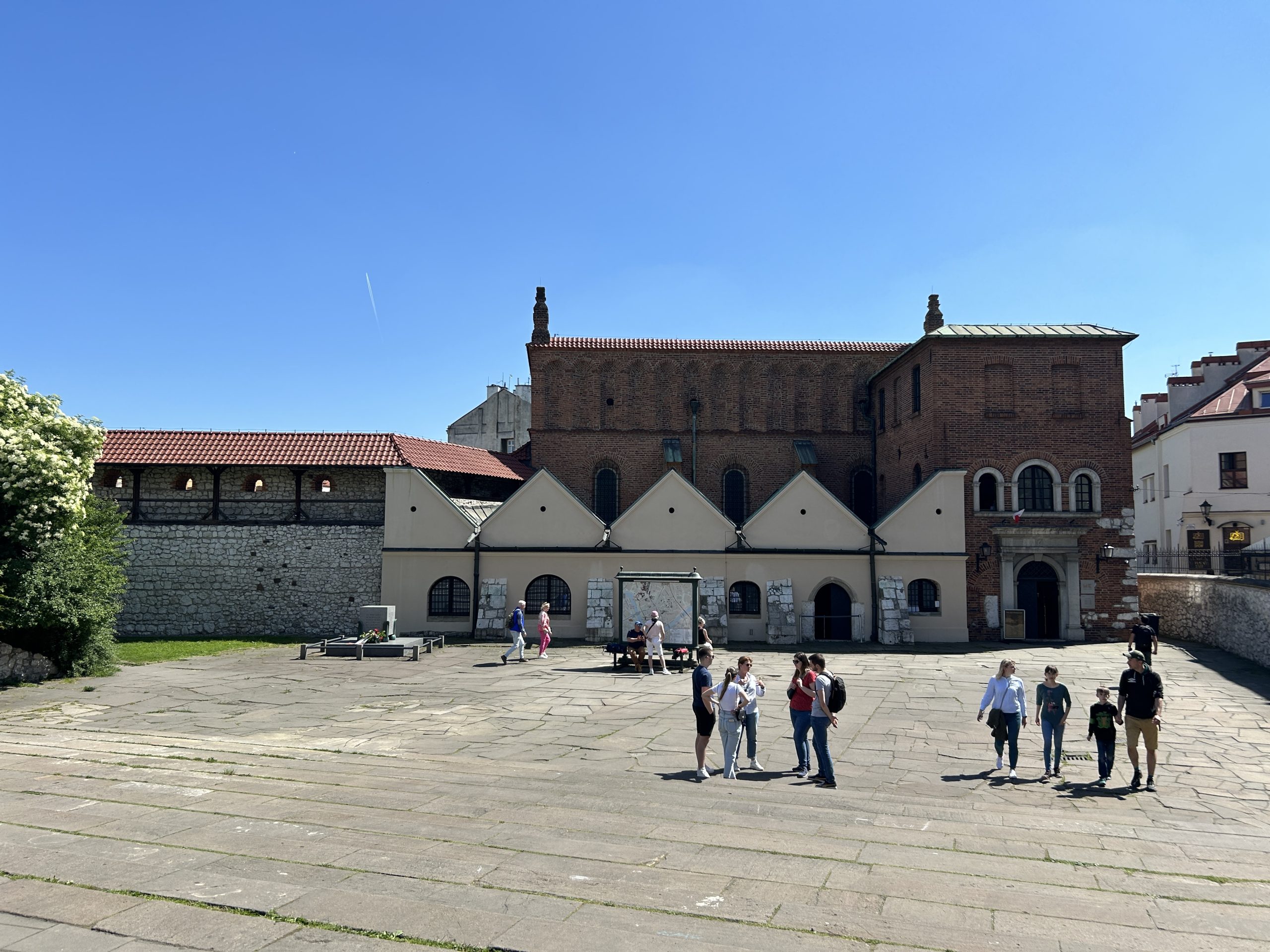
The photos above show the outside structure of the oldest synagogue ever built in Poland.

The ceiling art of the second oldest synagogue in Poland.
After the second synagogue we viewed what a Jewish cemetery looked like. Ewa talked to us about the significance of the rocks being placed on top of the gravestones, even referencing Moses in the Bible to explain it. Another part of the cemetery that was interesting was that the grass and weeds were not cut.
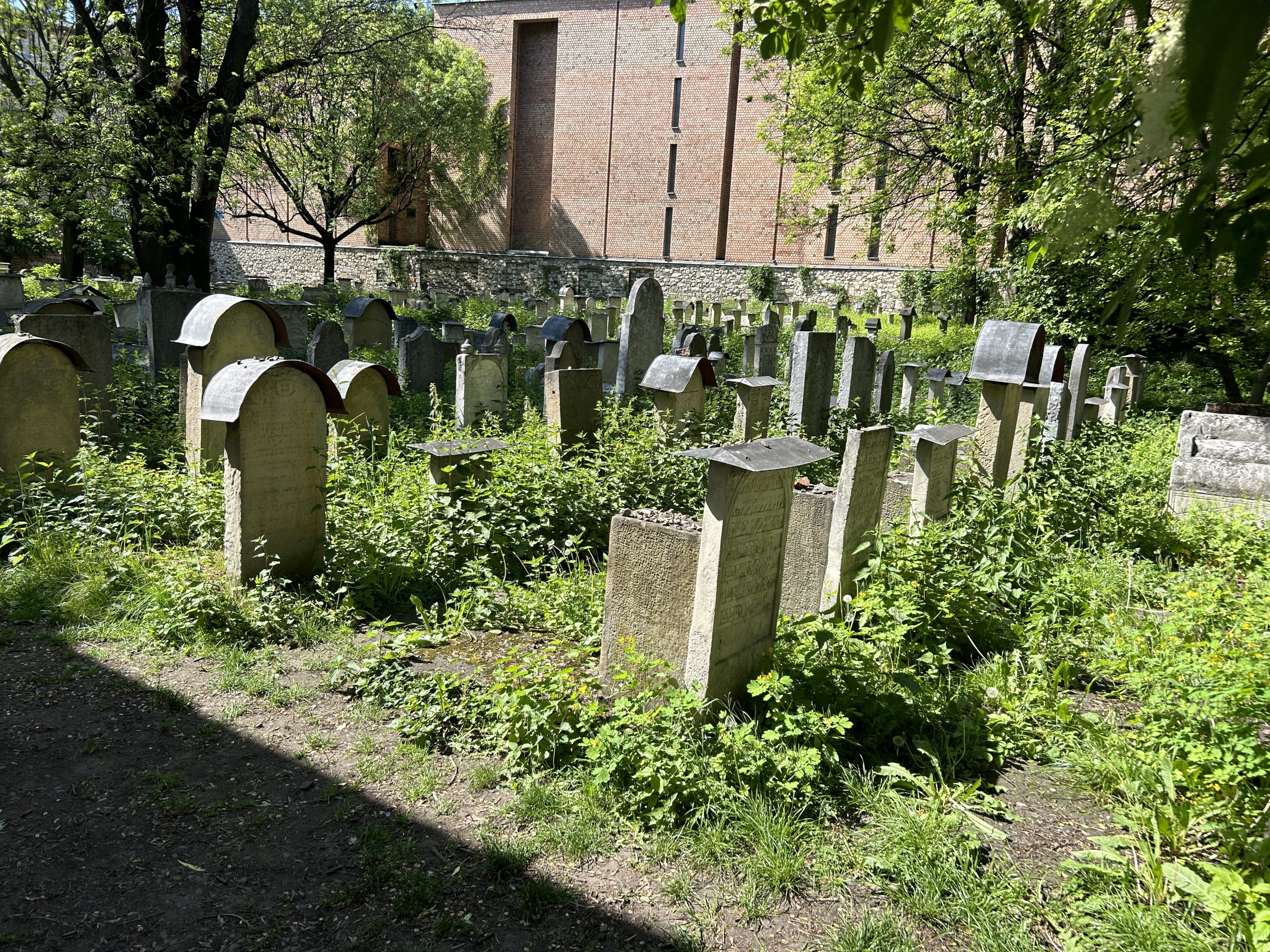
This can be seen in the photo above.
Ewa told us this was because Jewish people believe there is no reason to kill a plant to commemorate people.
In between these two synagogues I got the chance to ask Ewa what she thinks is the most significant part of this tour, and what would she mention if she was writing about this tour. Ewa said that what we are seeing now is drastically different than it was before World War II. She went on to say that synagogues were the center of the Jewish communities and played a major role in their everyday life.
She also mentioned that her great grandparents experience of Krakow is drastically different than hers now. When her great grandparents lived in Krakow about 25 percent of the population was Jewish, and there was 3 million Jews in Poland. However, after World War II there is only a couple thousand Jews living in Krakow, and this is a drastically less percentage of the population than before World War II.
This made me think of when we watched Life is Beautiful. As we see Giosue recognize the changes he is experiencing as a little boy under the Nazi reign as a Jewish boy. The scene that comes to mind is when he reads the sign on the door saying no dogs and no Jews. Which confuses him as Giosue is a young boy and the thought of antisemitism is still foreign to him.
We ended the tour looking at a memorial for Jewish people who died in World War II. I learned a lot through this tour as it gave me the opportunity to see structures and ways of life that were new to me.
