
Harrison Schafer ‘17 – Though we have been in Tübingen for just two days, I’ve noticed significant differences not only from Wabash, but also other German cities.

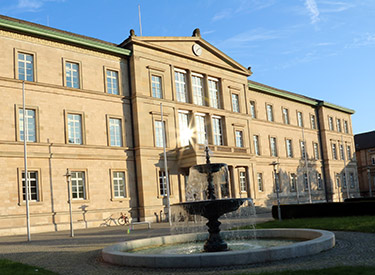
Elena Mezger, a former Wabash language TA, and her brother Pablo welcomed us to their town with open arms, as well as with gifts of chocolate & pretzels. Our group immediately embraced the city. These first few days have involved quite a few hours of exploring the city. Our first stop was fittingly the building in which we would be learning on weekday mornings: the Neue Aula. This lovely building houses classrooms for science and law, but it will be hosting our intensive German class for a few weeks.
Unfortunately for the students studying here, they do not have the luxury of rolling out of bed and strolling right into Econ 101, all within five minutes; their university is strung throughout the town. Not too terribly long after our first stop, we ventured over to the Neckar, the major river, which cuts through the German city. While passing over the river, the group stopped to enjoy the quintessential picture of Tübingen and its slice of the Neckar. Shortly thereafter, we found ourselves strolling through the Neckar Island, enjoying the calm waters surrounding lovely scenes of Tübingen’s greenery.
We were soon greeted by a daunting figure. Before us sat a large monument to Friedrich Silcher, a renowned nineteenth-century composer of “Volksmusik.” However, the artist did not sit alone. The group saw an odd juxtaposition of this German composer, fused with images of German soldiers. We learned that the Nazis in Tübingen erected this memorial in 1940. Utilizing Silcher’s music for the people, they sought to rally its citizens around passion for the war effort. As we wondered why such a statue would still stand today, Dr. Tucker and Dr. Thomas proceeded to explain; perhaps the German people chose to keep a reminder of the Second World War, creating a dual memorial: the statue itself, along with an informative sign to explain and contextualize the statue’s memorial function during the Third Reich.
We then broke into discussion; the group could not fully sympathize with the idea of keeping a memorial with such negative associations standing. Americans pride themselves on their patriotism, top to bottom. Surely, Americans would never keep a similar statue up, especially with the recent controversies surrounding Confederate flags. Fortunately for us, Pablo and Elena provided shared anecdotes about their German upbringing and about how Germany today still works to come to terms with its dark past: the frequent attention to the War throughout their education, the lack of German nationalism, etc. They talked about the new generation of Germans who are trying to balance the guilt of German history with a sense of pride for the role Germany plays in Europe today.
As mentioned earlier, Tübingen is a college town. Students breathe life into this city; with some 30,000 students, the students of the university compose a third of Tübingen’s population. Whether you eat at an Ethiopian restaurant or a cozy cafe, you cannot avoid the German students. As I walked through the university’s Mensa (their Sparks, or student cafeteria), faces both young and old soon were enjoying the day’s meal. That typical lunch hour looked ludicrously similar to our Midnight Munch with a sea of students coming together at common tables and breaking bread. Fortunately, we get to play pretend for a few weeks and “attend” this prestigious university.
With Elena as our hometown guide, we look to hone our German skills and perhaps fool a student or two into thinking we actually do study in Tübingen. Though we may be a tad more eager than our German counterparts in the Neue Aula, we have already tallied an effective three hours in the classroom, and I definitely look forward to more as I observe my progression over my two year stint studying in the German program.
