Jonathan A., Charles F., Brian G
School choice, nationally, has been a topic of debate since Wisconsin’s premiere program in 1989. Research across the board has yielded mixed results, and committees dedicated to analyzing various state programs have yet to be largely created. Indiana is on the forefront of implementing its own voucher program, being the largest program in the nation at approximately 33,000 students served, or about 3% of total Hoosier students. Indiana in particular has yet to look into the data from student choice since its implementation in 2011. Some argue the funds that travel with students to private/charter schools hurt the public schools that were left behind. Others champion the program as the ideal opportunity for student choice. However, the policies in place at various charter/private schools remove students’ choices from their own educational futures. With a decrease in voucher student test scores, an inconsistency of charter school success, and lack of effective need based policy, Indiana has seen subpar results with its expanded school choice initiative. Because of this, the state should reconsider its policies in favor of broader public school support. Below we detail the benefits and tradeoffs that the Indiana voucher program provides, as well as unanswered questions and further research that needs to be completed.
President Trump espouses the importance of student choice, as did former Governor Pence when he was in office. When Pence raised the average household income limit for vouchers, he presupposed that more students and parents would have the choice to move to higher performing schools. This simply is not the case. Private schools have the ability to reject students based on “economic status, gender, religion, academic achievement, sexual orientation, and…disability” (AASA). By selecting which voucher students to enroll or not to enroll, the ultimate choice is in the school’s hands, not the students or parents. This reality completely ignores any of the positive potentials posed by voucher advocates like DeVos. While there may be an investment in some students, their access is still just as limited as before, but with their own public schools being left underfunded with more and more students in need of better education.
Indiana’s voucher program claims that students can attend higher performing schools outside of their districts while simultaneously funding the private/charter school they transfer to. Unfortunately, the Choice Scholarships Program ultimately falls short of improving the education and test scores of these students. Betsy DeVos, head of the Department of Education states in an interview on 60 Minutes, “we should be funding and investing in students, not in schools — school buildings, not in institutions, not in systems.” Vouchers grant students the opportunity to attend schools with higher qualities of education. Many of the voucher students are in situations where they or their families are not financially able to attend schools outside of their local public institutions. While these vouchers, in states like Utah, have been used to assist those with special needs, there are arguably few reasons why one should not also expand these programs to all students. Indiana’s program allows students of all races, religions, and economic backgrounds to pursue these higher qualities of education. The reality is that these expanding voucher programs have not resulted in improvements, but have instead shown a clearer picture of the problems in our society. An increasing number of studies are starting to show the same poor performance by students on vouchers in presumably better schools. One of the earliest studies in 2015 found that “‘voucher students who transfer to private schools experienced significant losses in achievement’” (Carey). These programs try to enact triage on a struggling educational system unable to serve students, and while pieces and goals of the voucher program may be well intentioned, funding students and public schools will result in higher learning outcomes.
The goal of the voucher program is to provide students with an opportunity to be in an environment where they can and will perform to the best of their ability. According to a recent Notre Dame study, “students who transfer to private schools with a voucher program performed worse in math” (Schneider). This diminished performance was noted in relationship to the public school performance on math tests during the first and second years of voucher students’ attendance in private schools. The study clearly shows a failure in the mission of the voucher program, and the ineffective nature of its implementation. Pubic schools in other states show a great amount of success with their students. If Indiana can learn from others’ statistics, “67% of Louisiana’s public school students are passing standardized tests, whereas only 44% of voucher students do” (AASA). We must conduct more research with our voucher students to ensure a similar trend doesn’t happen in our state.
Although the voucher program was initially implemented to provide aid to low-income families with a choice of school, it is imperative to look at how these families are faring. In its early stages, the Choice Scholarship Program’s central scope was aimed at low-income students to compete with the upper-class’ opportunity to choose private institutions. Governor Mitch Daniels, during a 2011 press conference regarding the recent education changes, stated “Social justice has come to Indiana education” (Turner). However, after the expansion brought about by successor Mike Pence, more people were eligible for the program and the results from the reform have been less clear. Public education in the 20th century was the backbone of America, inviting more people into an educational system and providing the nation remarkable growth. However, this attempt to level the field and provide choices seems to now be disadvantageous to low-income families for both private and public schools. Independent school districts continue to lose money, push for a smaller budget for teachers, and in turn increase classroom sizes. In 2016, close to 20% of students who were in the voucher program had no record of attending public school before. Although it could be claimed that the opportunity for choice was evident for those families, is the program being thoroughly reviewed to understand how it can be abused? Jennifer McCormick, the state superintendent said, “I think Indiana is in an interesting situation right now because we have six years that we’ve had the program. Our charge right now is, what is that next step?” (Schneider). The next step is to evaluate the data we currently have on voucher students as well as reinvest in public programs that have been succeeding in spite of the 2011 voucher reform.
Given where we are in our voucher program, I believe we must commit to analyzing our state’s data regarding the program to decide future actions. Put together a committee dedicated to finding the discrepancies with voucher student location and voucher student performance. Below are graphs and charts with information we do have that provide a quick overview. To reiterate, in order to fully understand the impact the voucher system has on our state, more in-depth research must be conducted to determine if our outcomes are aligned with our goals.
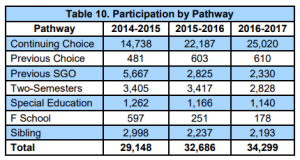
Table 10 from the Choice School Annual Report shows the various pathways in which students become voucher eligible. Over the course of the three years recorded, the voucher program has seen a drastic increase in students that have continued choice, with a decrease in students transferring because of failing schools.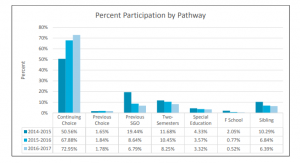
As seen above, the population of Continuing Choice participants is increasing yearly. This makes sense as students receiving vouchers in early high school would remain in the program until graduation. We should determine what percentage of the other pathways (Two-Semesters, Special Education, F School, etc.) are funneling into continuing choice and what percentage are new voucher students. If our goal, as a state, is to encourage st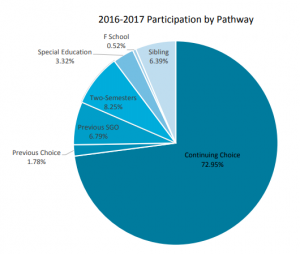 udents in low-performing schools to use a voucher to transfer to a higher achieving one, we need to figure out why only .52% of the population are participating.
To the right is a pie chart of the 2016-17 school year, divided by percent. There are 34,299 students total at this point in the program.
The next step in Indiana Education is to continue tracking trends in the data. Before establishing any major reform, we must be cognizant of the preliminary data we currently have recorded. Additionally, we must allow the changes made to take effect to see if, longitudinally, they are being effective. No matter the reform, preliminary data may not stick due to the effect change in policy has on populations. Information to focus on in future studies:
1.) Follow the students to see where they are coming from
2.) Record demographics of new students
3.) Determine if student voucher is necessary after 1st year of transfer, i.e. “how did the voucher affect family financial situation (if at all)?
4.) Look for trends in ethnicity, not only at the macro level, but by pathway as well
5.) Follow report cards of highest voucher enrolled schools, and look for variations
- By the opposite margin, follow schools that lose students and see their variation in reporting
It is likely still that these studies will only continue to confirm the concerns of the many critics of the voucher system. To truly catch up with the rest of the world, greater public funding, on par with other countries, will be necessary for American competitiveness in education. Moving forward, studies may also show the active segregating effect of these voucher programs. As noted by the encouragement to track trends in ethnicity and the aforementioned ability of private schools to carefully select students, these programs will serve to educate only the most well-off and privileged demographics of this country, while functionally incapacitating the larger public school system and the educational potentials of the students within it.
Works Cited
AASA, National Coalition for Public Education. “The Problems with Private School Vouchers.” LFA: Join The Conversation – Public School Insights, 26 Jan. 2015, learningfirst.org/blog/problems-private-school-vouchers.
Carey, Kevin. “Dismal Voucher Results Surprise Researchers as DeVos Era …” The Upshot, New York Times, 23 Feb. 2017, https://www.nytimes.com/2017/02/23/upshot/dismal-results-from-vouchers-surprise-researchers-as-devos-era-begins.html?_r=0
IDOE, Indiana Department of Education. “Choice Scholarship Program Annual Report.” Choice Scholarship Program Annual Report, IDOE, Aug. 2017, www.doe.in.gov/sites/default/files/choice/2016-2017-choice-scholarship-program-report-spring-revision-final-0811.pdf.
Schneider, Chelsea. “Are Voucher Students Improving?” Indianapolis Star, IndyStar, 17 Apr. 2017, www.indystar.com/story/news/education/2017/03/26/voucher-students-improving/97750824/.
Turner, Cory. “School Vouchers 101: What They Are, How They Work – And Do They Work?” NPR, NPR, 7 Dec. 2016, www.npr.org/sections/ed/2016/12/07/504451460/school-choice-101-what-it-is-how-it-works-and-does-it-work.
