

Between four European countries, six Wabash students studied classical-liberal ideas in historic cities this summer. As they considered the past and future of a free society, it was all made possible thanks to a generous grant that funds the college’s Stephenson Institute.
One site of these student experiences took place a few minutes’ walk from the British Houses of Parliament and Westminster Abbey, on a narrow street of an early 18th-century terrace of red-brown townhouses, a survivor of the Blitz and urban renewal. There on Great North Street you will also find the current home of the Institute of Economic Affairs (IEA), one of the UK’s oldest think tanks, founded in 1955. IEA became particularly prominent in the 1980s, when Prime Minister Margaret Thatcher sought to reform a sclerotic, low-growth country with a more free-market, deregulated approach to the economy. Now 70 years on, it remains a key voice in British politics, and in addition to its research and advocacy, hosts many university and high school students, particularly in the summer.
One Wabash rising sophomore, Hari Kumaran Sakthivel ’28, had been home visiting in Erode, Tamil Nadu, India before visiting London for the first time in early August—and was excited to participate in IEA’s Future Thought Leaders’ Program, with the Stephenson Institute providing housing and travel expenses. The seminar covered hot-button issues such as migration, taxation, property rights, health care, and foreign aid. “All the people there were really smart, and the program had a really nice structure,” said Hari, which included more than just lectures. In addition to debates, “we had a pitch competition where we had to choose a think tank from a list of options and pitch it to the audience” in a very short amount of time. Hari also noted the quality of the faculty running the seminar, noting in particular Steve Davies, who taught not only typical economic topics, but also “Economics of Video Games and Virtual Worlds.”
Carlos Cantu-Trevino ’28 of McAllen, Texas was also able to visit Europe for the first time. Arriving in Prague for three weeks in July, for a seminar run by The Fund for American Studies. Topics included political economy, conflict management, and current geopolitical issues (including the political situation in the Middle East and the conflict in Ukraine). With an international cohort of students from at least a dozen countries, discussions were so stimulating that “there were times that we just stayed until 2am talking politics,” Carlos said. At the end, they also had opportunities to enjoy the celebrated Czech capital, walking the historic streets and together noticing the influences of different historical periods, including communist and imperial architecture. The conversations continue with his new friends, though they now happen remotely: “I still keep in touch with some of my friends from South America and Europe.”
Also visiting Prague was Tanner Turnpaugh ’27, who participated in the Stephenson Institute’s own week-long summer seminar, “Classical Liberalism in Philosophy, Politics, and Economics,” co-sponsored with the Free Market Institute at Texas Tech. Turnpaugh noted his favorite talk was Chandran Kukathas’ talk about immigration’s benefit to an economy. Other lectures from the week included “Socialism and Economic Calculation” by Adam Martin, “The Challenge of Social Order: Voluntary vs. Coercive Means” by Institute Director Daniel D’Amico, and ”What We Can Learn About the Free Society From Tocqueville” by Christine Henderson. The itinerary also included a tour of the city focusing on “Totalitarianism in Prague.”
In Vienna, two Wabash students secured competitive internships at the Austrian Economics Center (AEC), one of Europe’s leading free-market research institutes.
Luis Martinez Chacon ’27 spent five weeks working under the guidance of AEC research fellow Martin Gundinger, focusing on projects related to both applied economic policy research and theories of knowledge. He read extensively in the Austrian School, including Hayek’s The Sensory Order, and collaborated with other students on a book project exploring philosophical foundations of economic thought. Luis found that “so many ideas or philosophies are propagated… and that shapes the economy.” He was especially inspired by discovering Hayek’s ideas about how the mind categorizes personal knowledge: “That’s how you start learning. You pair up things with your past experiences… and that’s how you keep projecting the world,” Luis explained.
His fellow AEC intern from Wabash, Preston Art ’26, also worked with Gundinger on book research, while additionally engaging in practical policy analysis. His work included investigating “a bait and switch scheme with foreign investors” in Spain where authorities were “taxing them higher rates than what they were promised,” and researching successful economic reforms in Ireland and New Zealand that could be modeled for Austrian policy. Preston was returning to the AEC for a second internship: “Last summer I was more of an outsider,” he said, but found himself more at home in Vienna on his return. This time Preston especially appreciated the networking events with “economists and scholars all across the world,” notably his meeting with an expert on digital currency. “For me,” Preston concludes, “living somewhere—versus just traveling—has offered a whole new perspective.”
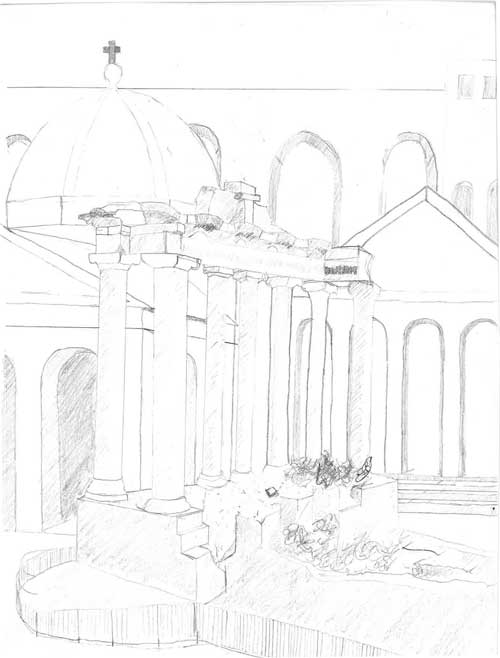
Another new perspective from a final student included learning through more than words. Christopher Royal ’26 took part in an art course in Rome for six weeks, where he sketched various historical sites and works of art. Throughout the course, he developed his art while gaining a deeper appreciation for the intersection of art, history, and politics, particularly in relation to Roman culture and architecture. “I never really thought of churches as being political buildings before … or about the political authority of the Pope,” said Christopher. “My roommates and I would talk about the different sorts of social norms and political norms of the time,” he explained, noting the connections between the built environment and politics.
These European adventures changed how six Wabash students think about freedom and civilization. They went from the classrooms of Crawfordsville to a new type of experiential learning—by living in the places where people have been debating these questions for many centuries.
