

In Washington, D.C., the stretch of Massachusetts Avenue from Dupont Circle to Chinatown has long been a street lined by public policy research institutes. Along with the Cato Institute, Brookings Institution, and Carnegie Endowment for International Peace, you will also find the American Enterprise Institute. Established in 1938, AEI has long been one of the established groups now known as “think tanks,” with an emphasis on free enterprise and limited government. Today AEI remains a powerhouse, employing nearly 200 scholars, who focus on a wide variety of issues, including economics, foreign policy, and social welfare issues.
Arman Luthra ’26, a Wabash computer science major, was hired as an AEI intern in summer 2025, where he focused on education policy. Spending his entire summer in D.C., and sponsored by the Stephenson Institute, Arman supported a research project that is gathering school leadership data from across the United States. What started as a goal to collect data from 10 percent of school districts has turned into a remarkable achievement. “We already have 70 percent of the data … and about 127,000 board minutes already aggregated,” Arman reported. The goal is to analyze this data, which is currently stored in various formats and locations by the approximately 14,000 school districts nationwide. By collaborating with scholars from top universities, they plan to use semantic analysis of the conversations used in these minutes. “If they have all of that data coming in real time, they can easily see if there’s a certain keyword that’s being used more and more.” Arman is excited for the project to continue. “We ended up making a novel technology that basically doesn’t exist,” he said. “I want to see this through.”
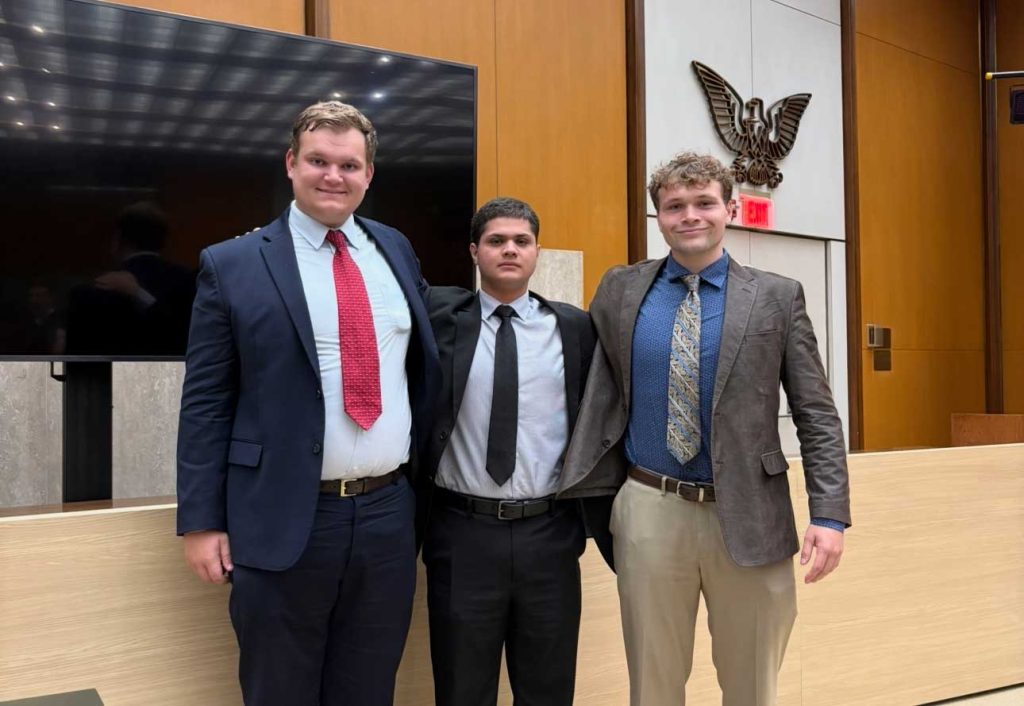
Three other Stephenson Institute students were also in D.C. over the summer, selected to participate in The Fund for American Studies’ (TFAS) undergraduate internship program. TFAS places students at policy-related organizations, including think tanks and non-profit associations, while also providing a biweekly evening seminar (American Economic Policy) and other networking events.
Through TFAS, Albert Bernhardt ’26 worked for Alliance for Innovation and Infrastructure, where he researched and wrote blog posts on related topics. His work included a piece published on “The Quantum Question: Can Our Infrastructure Keep Up?” Albert also collaborated with his colleagues on larger projects: “We spent the last three or so weeks working on this huge project where we were trying to find out a modernized figure for the total amount of underground infrastructure as of 2025 … The figure hadn’t been updated since the 90s.” Albert also appreciated the vibrant intellectual culture, seeing lunchtime lectures and enjoying “plenty of networking opportunities.”
TFAS places students in more than just typical think tanks, including civil society organizations, such as the German American Heritage Foundation. Hunter Otto ’27, of German ancestry himself, was excited to be selected to work there in their Chinatown office. Key highlights of his time included work on the Amish, a research trip on early immigration to Jamestown, Virginia, and visits to multiple D.C. embassies—including the missions of Austria, Poland, and Japan. The Austrian Embassy, Hunter explained, “was really cool because we got a tour of it, and there they informed us about Austrian immigration to America, how historically it happened.” His time at the Foundation deepened Hunter’s appreciation for cultural pluralism and freedom of association within the U.S., especially through studying unique German-American communities like the Amish. He also completed a large research paper on the topic: “I wrote the history of their faith from the Protestant Reformation all the way through today—and how they managed their economy.”
Finally, Diego Banuelos ’27 expressed interest in expanding his knowledge of foreign affairs, so he was thrilled to be placed by TFAS in covering the topic as an intern at the Daily Caller. In early June, Diego had just arrived in D.C. when Israel launched a surprise operation involving targets on numerous Iranian military, nuclear, and infrastructure sites. After over a week, the U.S. then intervened with airstrikes, codenamed “Operation Midnight Hammer,” on three Iranian nuclear facilities using “bunker buster” bombs. Without significant previous journalism experience, Diego was nonetheless learning fast. He was delighted to be bylined twice at the Caller, with one related to the Iran event, “Human Rights Orgs Tight-Lipped On Iranian Missile That Struck Israeli Hospital.”
