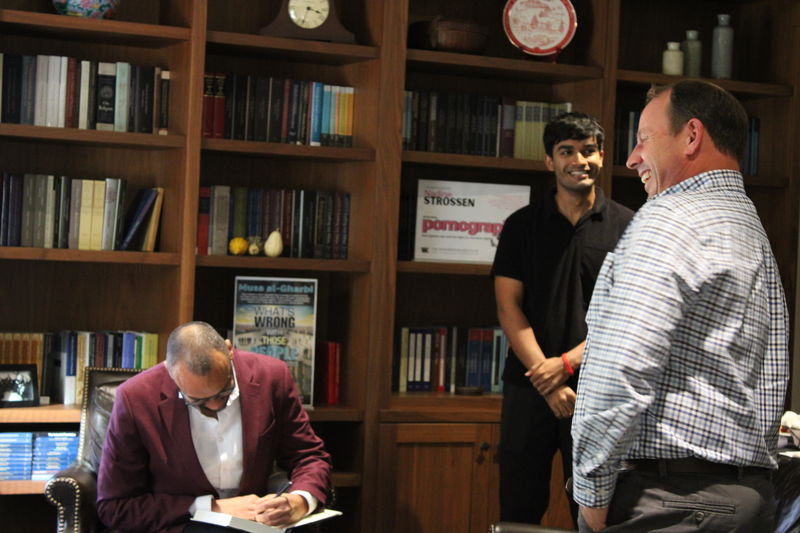

The week before the 2024 election, Dr. Musa Al-Gharbi, assistant professor of Journalism and Communication (and by courtesy Sociology) at Stony Brook University, visited Wabash and the Stephenson Institute to present his talk, “What’s Wrong with Those People.” In discussing part of his new book, We Have Never Been Woke, Al-Gharbi questioned why certain political parties in the United States are consistently viewed as wrong—and how bias in social sciences leads to this misrepresentation.
In his research, Dr. Al-Gharbi looked at different studies in social sciences, as well as media posts, that try to explain the partisanship of the United States political scene. In doing so, he started with a few simple questions about jagged lines, and asked which one stays more consistent, or moves more from where it started. The crowd in attendance could clearly see one line that moved far more than the other. He then cited a study that shows this diversion represents the Democratic and Republican parties moving more or less from previous positions.
Al-Gharbi explained how in this view, the Republican Party has stayed pretty consistent in all categories from racism to economic views, while the Democratic Party moved further and further away from the median. He then asked why it is the Republican Party is blamed by the media for this when it seems their party platform has not moved from the median at all. He explained how this bias is relevant in human nature, social science, the media, and some journalists.
Being a student in attendance, I found this talk to be quite persuasive. It brought to my attention the biases that we frequently see not only from both political parties, but also for many pressing issues addressed by the media. Regardless of one’s political views, this is an integral lesson for us Wabash students—as we are taught to think critically and act responsibly. Thus we must at times question ourselves. Instead of being overly confident in our personal prejudices, we must question how we could be right or wrong, and learn from it.